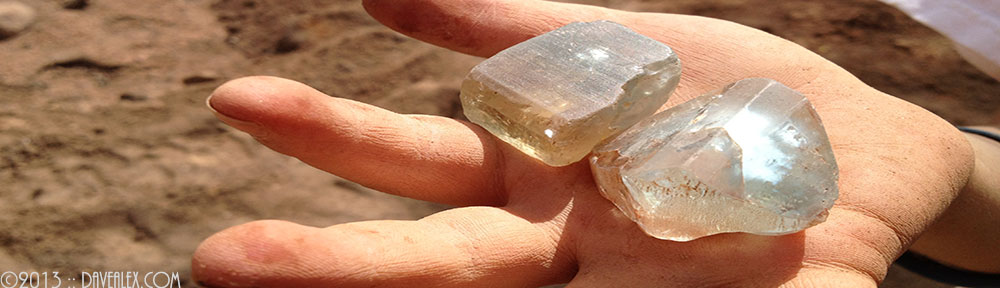

It’s always a fun adventure to visit the Dorris Family’s Topaz Mine here in Colorado. They allow the public to come by and dig several times per year as well as most of the Rockhounding clubs as well. Due to the late snow this spring this was the first dig, May 25th, 2013. I rounded up a group of adults and kids and we made the bright and early trek to the mine.
Joe and Krystle were telling us that they are working their way uphill a bit on their claim and that the stones are not as frequent as they have been in the past. I have been visiting for several years and I concur, although it seems (just an unscientific observation) that the stones that are being found are getting a bit larger. Perhaps that is not the case…
Anyway, we started digging on some fresh piles that were pretty wet and within about an hour I found my first topaz. It was completely covered in mud; usually they pop out and look gemmy/glassy and are very easy to spot; but this morning due to the conditions was different–making it more difficult to go through as much dirt as in the past.

People digging at the mine
Meanwhile, they were also working a section of the mine with the heavy machinery. Was cool to watch the big machines at work!
It is beautiful up here in the Rocky Mountains in spring time! Here I am raking through my part of a pile…
My friend Jim wanted to try out digging for Topaz and brought his daughter who is friends with my son. My daughter Daphne also brought a friend that was in my Rockhounding enrichment class at the Larkspur Elementary school. There were several other kids digging as well; unfortunately they didn’t find all that much topaz; again I think luck had some to do with it but also the amount of dirt one must go through as well. They did have a blast though!
We ended up getting our days fill about 2:00 and drove home, made a pit-stop and had had some orange cream soda and a beer at Bierwerks in Woodland Park, and headed home to sift through the bags of dirt. Here is where the kids got to find and keep some wonderful stones….and they wondered why they had to dig all day when it was this easy!!!

Sifting through our bags of dirt; the kids did quite well!
All in all, another wonderful day at the Topaz Mountain Gem Mine! I should have at least one more trip, probably more, back there this summer. Looking very much forward to it!
Here are what my kids found at the mine (the larger one is one of the many found in the bags of dirt!). Makes me think of some of the lamer parts of the Prospectors show on Weather Channel… guns and gems…

My kids findings...gems and brass
My findings from digging all day…


Nice smokey quartz; double-terminated; a cutter!

The best cutter stone I found

Cute blue faceted gem! Small but beautiful!
Finally, the best for last. One of the first time diggers there pulled this beast from the ground. It was absolutely spectacular. Joe stated that this stone was one of the best (upper 1%) stones he has pulled out of the claim; and is likely one of the best ever found in Colorado. Unfortunately the person that found it didn’t get to keep it (obviously!) as it was destined for the Dorris personal collection! This stone was (I’m guessing) 600 carats and nearly flawless. It didn’t hurt that it was Sherry and Blue bi-color! Looking at this stone was mesmerizing, every angle had a different look and “feel” to it. A special day to witness this being pulled from the ground next to us, and to view a stone of this caliber!

Absolutely gorgeous bi-color monster topaz found today!

Bi-color Incredible Topaz found today

Monster Topaz - Showing the facets, perfectness, and sherry color
Thanks to Harold Alexander for some of the mine pictures, and thanks to Krystle Velasco/Joe Dorris for letting us take pictures of the mine’s wonderful mega-stone!
Today was a great day and my second outing for the year, this time to the New Hope Amethyst lode claim as guests of the Canyon City rock club. I was with the Lake George Gem and Mineral club , there were 5 or 6 clubs on this field trip. Lots of eager Rockhounds wanting to get out find some amethyst quartz crystals!! The day was slightly overcast which was perfect for a day of digging–bright but not too hot or sunny.
I started the day doing some prospecting and walking around the claim and surrounding public lands. I found some epidote in quartz/granite which was cool; but nothing else per se. Richard, the field trip leader for the club, had given me a clue on where to find some calcite crystals so I went on a hunt for them. I was able to find the area he mentioned; but obviously someone had been digging there already and I didn’t see the calcite crystals he mentioned. The seam that had been dug out had some dried red clay and I figured I should see what that was about so I started digging in that carefully. I ended up finding a small plate of small calcite points which was exciting. Unfortunately the host rock was extremely brittle and even exercising great care it was hard to extract the plates without everything busting into tiny pieces.

Cute calcite cluster found in the maroon clay
I continued to dig into the clay and uncovered more small plates of calcite crystals, again they were very brittle but I was able to extract a couple 1.5 – 2″ pieces intact which was exciting! Continuing into the pocket I the clay turned iridescent maroon colored and that is where I found a couple of really pretty plates, one, the back/side of the pocket was able to be extracted intact that was rather large, 4-5″ long. Sweet! The below cluster was one of the intact small clusters which came from this area of the small pocket.

Calcite cluster without the coating of calcite

Awesome large cluster of calcite crystals intact!!
Once I got to the end of this small pocket I broke into a small but pretty smokey and amethyst quartz vein. It quickly pinched out and I decided to see what everyone else was finding and relax for a little bit. Overall the calcite pocket was about 3-5″ high, 1-3″ wide and about 4″ deep at the largest points.

"Zipper" Vein of Smokey and Amethyst Quartz at the end of the Calcite pocket
Everyone was having luck about two feet deep digging an amethyst vein. There was a lot of folks digging in a tight space so I decided to try and intercept the vein a little ways away from the crowd; 10 yards or so uphill. I dug and dug in all directions but did not find the vein…it either made a significant turn, went further down than I was wanting to dig (which was 3+ feet!); or pinched out. After a couple of hours I reclaimed my prospecting and just hung out and listened to everyone talk and enjoyed the stories and watching everyone find great little clusters.

Small amethyst, milky and smokey quartz clusters and points
I went through some of the tailings and found some cool little points, and after everyone was done they offered me a chance to dig in the excavated hole and I enjoyed about an hour of finding great small milky quartz covered plates before it was time to head home. It was a wonderful day with great people; I’ve really enjoyed visiting this claim and appreciate the opportunity to do so!

Needs a little more scrubbing; beautiful amethyst and smokey quartz!

Calcite crystals in close proximity to quartz vein

Been a while since my project Freq Modif has been active; but that sleeping beast awakes. Right now there is a Facebook page and a Soundcloud page. I have 25+ tracks ready to go online; I’m going to add them a few at a time–much like a glacier melts–so does the Freq Modif archive to create a constant stream…
And the patch above was my dad’s; he was a Radarman in the Navy. I love the patch and it hangs in the studio with all the electronics equipment!

Moog 901-A Oscillator Controller, Drawing 1100, July 2, 1969
About 16 years ago I bought a PolyMoog Synthesizer from a Pawn Shop up in Brighton. It was in good shape and came with the PolyPedal, but didn’t have the legs or power cord. I found a computer power cord in the shop and asked the broker if I could give it a try. At first he was reluctant, but then allowed me to try. It acted as if it had a stuck key; I knew this could be a much bigger issue than just a key; so I talked to him and got a really good deal on it!
I bought the schematics and operations manuals online and took it apart and looked to see if it was something mechanical or “simple”…but I was unable to figure out the issue. I figured I’d send it out to a tech sometime; but given its weight I wanted the tech to be close to home. Meanwhile, I found a PolyMoog Road Kit on eBay and I won that auction. This parts kit was essential for bands who were on the road with one of these beasts, so I was told. This came from a former employee that worked in the Moog Trumansburg Factory. He included with this auction lot several Moog schematic blueprints and an EMU modular catalog!!!
Fast forward 15+ years… I found a great tech here locally just a few months back (Chris Rowland, offbeat electronics) — who I highly recommend, btw — who has put to good use that PolyMoog Road Kit. I hope to get my Moog back in pristine working condition here shortly. Meanwhile, I finally took some photos of these schematics that I have framed and hanging in my man-cave. Click on them for a larger image; and some didn’t come out as clear as I wanted; if you want higher resolution let me know and I’ll work harder to get a better shot!
If you have any of these, or have images or links to others, please post in the comments; I would love to see more! These look great framed and hanging on the walls!

Moog 904-A Low Pass Filter Schematic, Drawing 1149, July 25, 1967

Moog 904-B High Pass Filter Schematic, Drawing 1118, December 1966

Moog 905 Reverberation Schematic, Drawing 1104, July 26, 1966

Moog 961 Interface Schematics

Moog Synthesizer 10 Schematics, Drawing 1374, December 30, 1969
Was absorbing the beautiful spring weather of late, with a cocktail in had, and decided to record a little mixtape. Far from perfect mix; but not too bad given I was highly distracted. Much variety here as it was just a lounger.
Warm Spring Sun Mixtape by Davealex on Mixcloud

Roland Home Series Synth Plus 60
I found this locally from a really cool guy near town this week. Ended up heading up during a blizzard and was stopped on the interstate due to multiple wrecks…ended up getting led off the interstate by turning around and going the wrong way to the nearest on-ramp…I thought the synth was gone as the seller said there were other interested parties…but the next day it was available and I went to pick it up.
The synth overall was in wonderful shape; there were only two real issues with it:
1) The rate slider was broken off; thus missing the slider cap too.
2) The Bender plate/mechanism is pretty loose.
3) The sheet music holder is missing
4) There is a screened on logo of the keyboard store in Omaha front/center of the unit (I would never have bought this new with that on it!)

Great shape except the broken slider, and screened logo of the original seller!
So, I pulled out the schematic from the internet and saw that all but the HPF sliders are 50K so I found one (with a Juno slider cap!) and have it on order. I should have this early next week and will pull this apart and fix that slider and tighten the Bender plate! I’m going to not worry about the other two issues.

Close up of the Control Panel...
The HS stood for Home Series and Roland had several in this line during the mid-80s. The thought I think was to give these to aspiring musicians and people taking piano lessons at home or school. To make it more “home” friendly they stripped the colors of the Juno-106 and added speakers–which sound very nice in my opinion!

The interface of this synth! MIDI In/Out/Thru and program protect are not shown
Even though there is only one DCO per voice; this 6 voice machine has classic, wonderful sounds. You can stack all 6 DCOs at once which has a really thick and aggressive sound! You can also add one of the two Chorus features which also thickens the sound…the Chorus functions are really sweet! I have owned several Juno-106s in the past; but for whatever reason I got rid of them (trades, etc) and lately I have been wanting back that “classic” Roland sound back in my studio! That occurred this week! I also got a hefty anvil case with this synth, although its a pretty tight fit…

The heavy duty Anvil case
Both kids like it as well! I look forward to plugging it into the genoQs Octopus sequencer and having some fun! I’ve also picked up the Roland JX-3P lately so I think I’ll have a dueling Roland session with the Octopus soon!
RESTORATION UPDATE: 4/27/2013
I purchased a 50k slider on eBay that had a slider cap (unfortunately white) and finally got around to taking the HS-60 apart and replacing that slider. Pulling off the 5 screws per side in the plastic siding, and then the 2 screws per PCB (main PCB and MIDI) on the back, and finally the 6 or 7 screws from the panel PCB.

HS-60 encased speakers
These speakers get REALLY loud; I usually have the volume at 3 or 4. The inside of the synthesizer was VERY clean!

Juno 106 and HS 60 Jack PCB.
The boards and assembly are really professional in the HS-60. The panel in on a taught hinge which made it really easy to work on.

The Panel Board - 50K rate slider Fixed!
The LFO rate slider is all the way on the left. This 50k slider was super quick to replace once I got to it. I had to take off the Panel PCB, MIDI Jack PCB and Jack PCB. Overall, this took about 45 minutes to complete.

Cool HS Shadows
Purchased a Roland JX-3P synth today, Roland’s first Midi synth from 1983 timeframe. I have owned 3 Juno-106 synths over the years but I didn’t like the stair step filter sound so I sold them off…but over the years I find myself missing the classic sounds…so I was excited to pick this synth up!
It has the basic layout as the Junos, having an extra DCO which is cool…but it does not have the nice control sliders like the Juno-6, 60 or 106 does… I am actually excited (so I have read) to learn the with the on board sequencer you can overdub with it which is exciting. My buddy Brett has a PG-200 programmer that I can borrow to easily program out the 32 programs! There is also an after market cpu upgrade that looks very intriguing…but is $300 including shipping from New Zealand so I lost a little excitement due to the sticker shock!

Roland JX-3P upon initial inspection
There were many issues with the synth when I got it.
1. It was filthy and smelled heavily of cigarettes, so much that you could barely see the LEDs light up! That was pretty easy to fix with a good cleaning.
2. There were many screws missing, especially the ones holding the keyboard to the chassis. That should be easy to fix with a trip to the hardware store.
3. The selector slider works but it has a horrible metal-to-metal feel and sound.
4. The rate slider is completely broken.
5. The volume knob/cap is gone
6.The output jack is busted.
7.The lowest C key does not trigger at all
8. A higher E key sticks.
9.The volume pot is not connected to the PCB very well; and it needs some lube to get some of the static out.
I was pretty lucky and found a used jack board for $40 and new sliders for $15 each, these are on their way now. That will be some soldering, not a big deal…so that just leaves the slider cap for the rate and the volume knob. I may not replace these with the original parts, i am going to do some looking at old used electronics dumps and online to see what I can find…I should hopefully be able to re solder the volume pot in; I just discovered this issue; haven’t checked if the PCB is broken or not…could be a bigger issue. This should be basically (less the C key) back up and running very soon! Will check into the contacts of that C key as well! Cannot wait!!!
Here it is after the initial cleaning:

Roland JX-3P after the initial scrub-down
UPDATE: 2 days later…
I plugged it in and played with it for a couple of hours last night. After figuring out the user interface it actually is pretty easy. Any parameter is 2 button presses away. The quick reference chart in the upper right side of the faceplate makes it super quick to zero into a parameter. I actually like this implementation; much better than the later “tiny window” and scroll wheel that became huge later into the 80′s and 90s! The implementation is very nice considering there are no real-time knobs/faders to control the sound! Good job Roland…you went down-hill for years after this!
To my surprise, the “stair step” sound of opening/closing the filter that the Juno-106s had to my dislike IS NOT THERE; it is a smooth analog feel when sweeping the filter! WOW, a cool extra bonus! I played with the mixer and both DCOs and there are quite a bit of variety in modulating the sound that can happen this way. So far, I’m very impressed with the sound capabilities; I just wish there was velocity on the keyboard…this appears to be a HIGHLY under-rated synth (from a price/desirability perspective–due to the lack of sliders/knobs); probably people don’t understand they can spend <20 minutes required to get used to the fairly straight-forward user interface. Rich analog sounds galore!!!
Here is a quick overview of how to program this great synth:

Roland JX-3P Quick Reference screened on the front
Here are all the parameters that can be used to craft sounds…a great quick reference on the front faceplate! Note there are two sets of parameters, numbered from 1 to 16 labeled in either “white” and “red”.

Roland JX3-P Master Control
Step #1: First press the Edit bank button corresponding to the parameter you desire to adjust (Group “A” is white while “B” represents those parameters screened in red).
Step #2: With the “color” selected, the parameter number from the Edit-Map reference is selected using the 16 preset buttons. For on/off or multiple position “knobs”, you will use the bank buttons (A - D, on the left)–the value will be shown by a illuminated LED. Otherwise you use the “Sens” slider to choose a value for the parameter–each is divided into 16 step values and the current value is illuminated on the corresponding preset LED/button.
If you are needing to change another parameter and it is in the same “Group” you are one click away…simply press the corresponding preset button/LED and use the Sens slider to adjust. If the parameter is in the other Group color; then you will need to press that Edit Bank Group button first. A parameter is always less that two clicks away!
Step #3. Once you have your sound as you like it, to write to one of the 32 available user presets make sure your Group button LED is off (out of edit mode) and then press the Edit Write button, the Group button you want to save to (either C or D; A and B are presets that can not be saved over) and then the Preset number button.
Pretty darned simple if you ask me.
I’ll add more soon, once I get the parts and open this up to fix all the problems…until then; I’ll be programming some new sounds and hooking up to a MIDI controller.
UPDATE: 1 Day Later…
Wow, my parts shipped quick. I ordered them last Friday and they were here today, Monday. I had a few hours before the family came home so I decided to dig into this and see how far I could get.

JX-3P Opened up and ready for surgery
First, fix the couple of keyboard issues: Lowest “C” is not triggering and the upper “E” is very loose.

Upper "E" key (and black note next to it) were broken
I pulled out these two keys (I didn’t realize the black key was also very “loose”) and super-glued the parts back on…

Broken keys and parts after extraction from the assembly
<

The Super Glue Fix...
Now to the low “C” that didn’t trigger. I noticed that the rubber was raised; probably got some dust under there…

Contact was raised...
I took an eraser and lightly cleaned both pieces, and then took a cotton swap and some isopropyl alcohol and cleaned this up. I then put the key back on. That seemed to do the trick! All the keys are solid and now work!
I then replaced the jack board. It is obvious that this synth was dropped; much like humpty dumpty it had a GREAT fall! The jack was still soldered to the pad; but the pad was broken / cracked from the traces. The hex bolt was also forced off, both which allowed the jack to be very loose and not function properly. Regardless, I replaced the entire jack board.

Notice the crack / broken trace.
Next to the volume pot. Same thing, it obviously suffered trauma and the pads were broken from the traces. I repaired these by adding some hookup wire to reconnect the traces; and then re-soldered the pot to the PCB. That seemed to work as well!

Traces were separated from the pads...

This is why the volume didn't work well...
Finally, I replaced both the Rate slider (which was completely broken off) and the Sens slider. These I got today in the mail. These have a nice feel now!

Broken Rate slider
So, four days after getting this wonderful synth, it is nearly completely restored. I have one slider cap (from the broken slider) to replace…I may replace all 3 depending on what I find. I found a nice knob in my collection for the volume; so that looks good now too.
Overall, a very fun (and quick) restoration project! Now, time to make some tunes!
We have been working this winter on going through the archive and putting a seal on it; we have about 7 or so tracks left to edit down from the last set of shows in 2010 and 2011. We have recorded some new great tracks (currently doing the finalization of edits) that will also be posted here shortly. But in the mean time; here are four new Multicast tracks posted on Soundcloud and obliq.net.
Here are the links over to the Obliq Recordings website…
Multicast presents Faster and Faster
Multicast presents The Spy
Multicast presents an Interlude
Multicast presents Merry Go Round
Enjoy!